


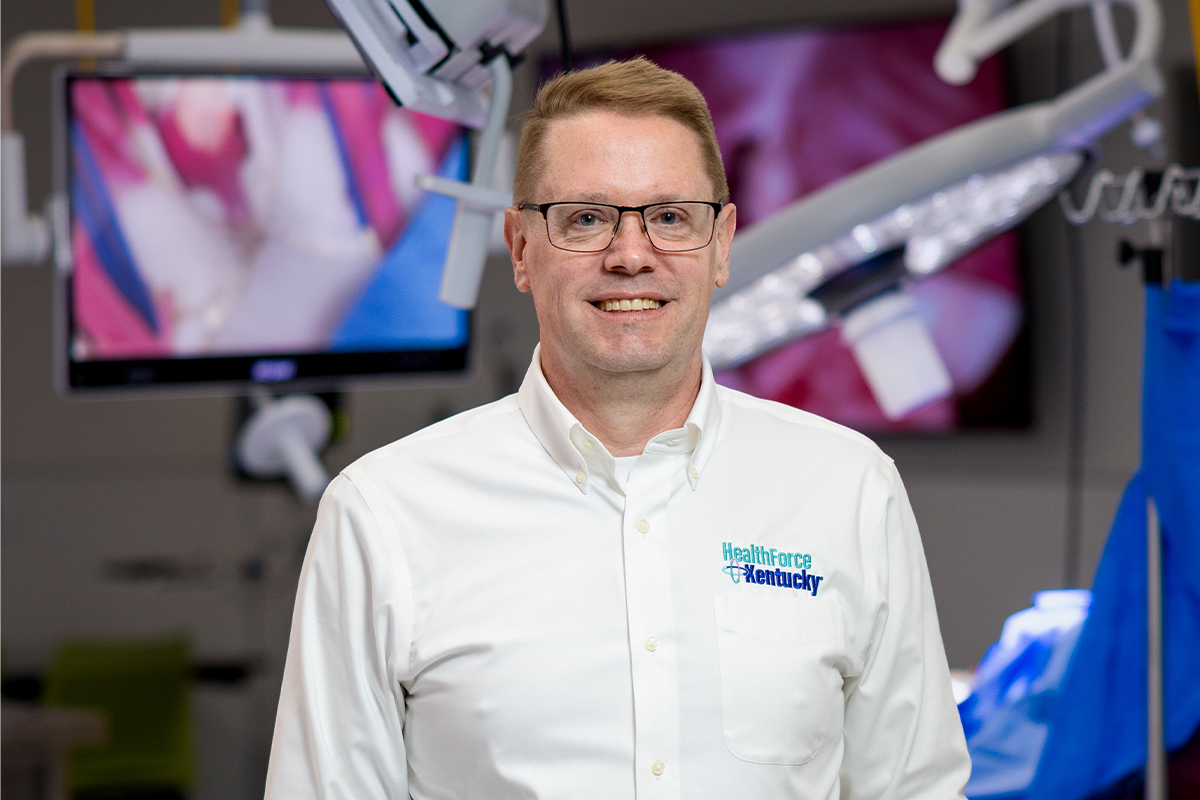
How Williams, HealthForce KY are shaping the future of healthcare
Bruce Williams did not set out to build one of the most advanced healthcare simulation and workforce training centers in the country.
Growing up in Spurgeon, a small town in Pike County, Indiana, Williams said his first degree was in computer-aided industrial drafting. He spent one summer doing that work and quickly realized he didn’t want to spend his life behind a computer.
Then came a helicopter ride.
“I got an opportunity to fly on a helicopter on a tour, kind of a public relations flight out of Evansville,” Williams said. “And that pushed me into becoming a nurse.”
That detour became the foundation for a career that has stretched from the intensive care unit to the emergency room, from Life Flight to nursing education, and eventually into the highly specialized world of medical simulation.
Today, Williams serves as president and CEO of HealthForce Kentucky, the Owensboro-based initiative created to help address healthcare workforce shortages by building pipelines into the profession. Under his leadership, HealthForce Kentucky has moved from a concept backed by state investment to a growing regional operation with mobile training units, equipment lending, field trips, summer camps, simulation-based education, and a newly opened Innovation Center in Owensboro.
Williams’ own route into that work was anything but traditional.
After becoming a nurse, he started in the intensive care unit at what was then Welborn Hospital in Evansville. He later worked in the emergency room and spent six years flying on Life Flight. His career also included occupational medicine, organ donation, and six years as a nursing faculty member at Ivy Tech in Evansville.
That teaching job changed everything.
DISCOVERING THE POWER OF SIMULATION
On his first day, Williams said, he was told the school had purchased mannequins years earlier but had never fully used them.
“They said, ‘We haven’t done anything with them. We don’t know exactly what they do, but they’re over there,’” Williams said.
So he started pressing buttons.
The mannequins came to life. Students responded. And Williams saw something bigger than a novelty. He said students began to see new capabilities and things that they weren’t able to do consistently in clinical.
For him, simulation offered something traditional healthcare education often could not guarantee. Instead of having to wait for a student to encounter a stroke, a diabetic emergency, a GI bleed, or a heart attack during clinical rotations, instructors could now create those scenarios on demand. Students could be exposed to critical situations before graduation, and they could do it without a real patient being placed at risk.
That idea helped pull Williams fully into the simulation field.
He moved from teaching into a simulation technician role with Indiana University Health, then rose through management and director-level positions while working in four simulation centers in Indianapolis. Later, he went to Texas, where he helped design additional centers. Along the way, he found an unexpected connection between his two professional worlds.
The drafting background he once thought he had left behind became useful again.
At Ascension in Indianapolis, Williams helped lead a major project that turned a demolished 220-room hotel site into a 50,000-square-foot simulation program. Design, layout, and spatial planning all mattered. The same was true later in Texas, and again in Owensboro.
“This is the fourth one that I’ve had the opportunity to design and work on the build,” Williams said.
DESIGNING A NEW KIND OF TRAINING CENTER
That experience shaped his view of what a simulation center can be. In the industry, he said, there is a common phrase: If you’ve seen one sim center, you’ve seen one sim center. No two are exactly alike.
But Williams believes HealthForce Kentucky stands out even among that variety.
“I’ve not found any that have all the technology that HealthForce Kentucky has access to under one roof,” he said.
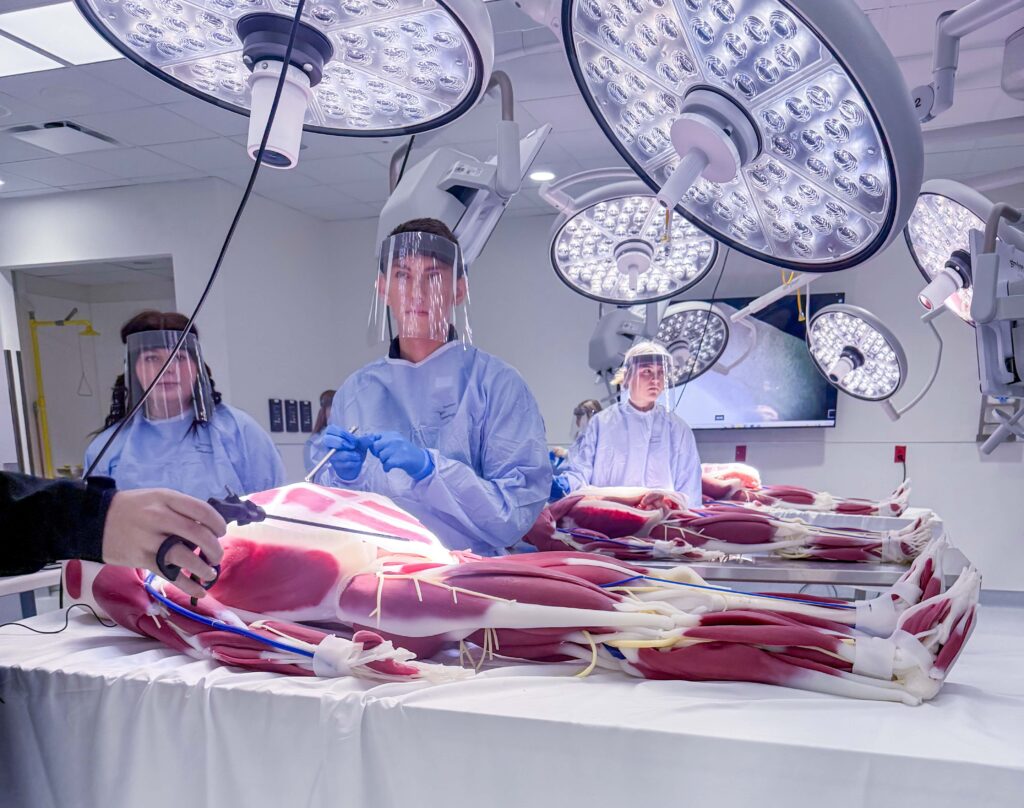
The Innovation Center includes physician office rooms, inpatient hospital rooms, nursing and multi-skills labs, an operating room suite, an X-ray suite, a laboratory and anatomy lab, debrief rooms, collaborative spaces, teleconferencing rooms, immersive simulation rooms, a home environment, and a Serenity Chapel for reflection and decompression.
In another era, Williams said, healthcare training followed a far rougher formula: see one, do one, teach one.
Now, he said, the model has become something closer to see one, practice many, then do one.
“That first chance to try something new is no longer on a patient,” Williams said. “We’re able to create that in the laboratory, in a safe environment for the learner, but also for the patient.”
That approach has become increasingly important as healthcare systems grow more complex and the margin for error shrinks. The technology has also improved dramatically.
Williams said early simulation tools could perform many of the functions seen today, but the realism and feedback have advanced substantially. Some mannequins now record whether a learner checked a pulse correctly, assessed pupils properly, delivered quality chest compressions, or intubated successfully. In a high-stakes testing environment, that data can help validate whether someone met the required criteria to move forward.
Just as important, Williams said, is what happens after the scenario ends.
He describes debriefing as one of the most valuable parts of simulation-based learning. Learners go through an experience, then reflect on what went well, what did not, and what tools they need to improve. It is interactive, practical, and especially effective for adult learners.
“I am this kind of learner,” Williams said. “And this engages.”
That same hands-on philosophy shapes HealthForce Kentucky’s broader mission. The organization is not focused only on students already on a college healthcare track. It is also trying to reach younger students, rural communities, and nontraditional learners who may never have pictured themselves in a healthcare career.
The effort is rooted in a state mandate.
FROM CONCEPT TO STATEWIDE IMPACT
Williams said HealthForce Kentucky’s original direction from the legislature centered on “pipelines and pathways.” Kentucky lawmakers, he said, recognized a workforce emergency in 2022, with too few qualified people moving into critical need areas. The goal was not simply to talk about shortages, but to widen the funnel.
“The funnel was not full of people looking to work who were qualified,” Williams said.
HealthForce Kentucky’s mobile units became an early answer to that challenge.
Williams joined the organization in October 2023, around the time HealthForce One was rolled out. HealthForce Two followed in August 2024. The building itself opened in February 2026. Before the Innovation Center ever opened its doors, Williams said the organization had already traveled 21,000 miles, reached 21,000 learners, and completed 542 events through its mobile programming and equipment loans.
Those mobile units were designed to let HealthForce Kentucky start its mission before the permanent center was complete and to extend that mission beyond Owensboro. Both units can serve as deployable medical assets in a disaster if needed, though Williams said the main purpose is workforce development. On board, students can rotate through stations representing careers such as medical laboratory science, physician assistant studies, nursing, radiology, EMS, paramedicine, and respiratory therapy.
“I like to say we can go further faster,” Williams said.
That mobility matters especially in rural Kentucky, where opportunities can be harder to access and where long drives often create extra burdens tied to transportation, child care, and time away from work or family. HealthForce Kentucky is now expanding its service area more broadly across the Commonwealth, a move Williams sees as central to its purpose.
“We’re important in the workforce development in the rural area,” he said.
The idea, he said, is to help people begin locally and, ideally, remain connected to their communities. Even entry-level healthcare jobs can create momentum, he said, leading to employment, insurance, tuition assistance, and continued education.
That same ecosystem approach appears in HealthForce Kentucky’s partnerships.
Williams said roughly 15% of the initial investment went to expand programs that increase the funnel of future healthcare workers. That support helped institutions launch or grow programs in fields tied to workforce needs, including counseling, sonography, radiology, and medical laboratory training. HealthForce Kentucky also offers equipment loans so schools, hospitals, and other partners can access advanced tools without having to buy expensive mannequins or systems that might sit unused for most of the year. Another piece of the outreach includes classroom enhancement resources and STEM activity kits designed to support career exploration and align with Kentucky Academic Standards.
OPENING THE DOOR FOR FUTURE WORKERS
At the Innovation Center, that mission is now becoming more visible to the public. HealthForce Kentucky is booking field trips and in-class experiences and preparing summer camps meant to introduce students to healthcare through immersive, hands-on learning. Those programs are designed to inspire curiosity early, before a student rules out the field or assumes it is out of reach.
For Williams, that may be the most important point of all.
Healthcare workforce development can sound abstract in policy conversations. But in practice, it often starts with exposure. A student steps onto a mobile unit. A class visits the Innovation Center. Someone who never imagined a future in radiology, respiratory therapy, or nursing suddenly sees a path.
That is the work Williams has spent years building toward, even if he did not know it when he climbed aboard that helicopter near Evansville.
A drafting student became a nurse. A nurse became an educator. An educator became a builder of simulation centers. And now, in Owensboro, Williams is helping shape a model designed to bring more people into healthcare and better prepare them when they get there.
In a state and a nation still grappling with shortages, that may be the real promise of HealthForce Kentucky. It is not just a high-tech building full of impressive rooms and advanced mannequins.
It is a doorway.
And for many future healthcare workers, it may be the first one that feels open. OL