

Greg Alvey turns tiny spaces into works of art
Photos by Jamie plain
At first glance, the mystery of a ship in a bottle seems almost impossible to solve.
The ship is wider than the neck. Its masts stand tall, sails stretch across miniature rigging, and sometimes tiny sailors climb through a scene that appears far too elaborate to have ever passed through the opening.
For Greg Alvey, figuring out how it all gets in there is part of the fun.
With bits of scrap wood, homemade wire tools, plenty of planning, and even the occasional discarded surgical instrument, Alvey has spent decades building, collecting, researching, and restoring ships in bottles and other forms of what collectors sometimes call “bottle whimsies.”
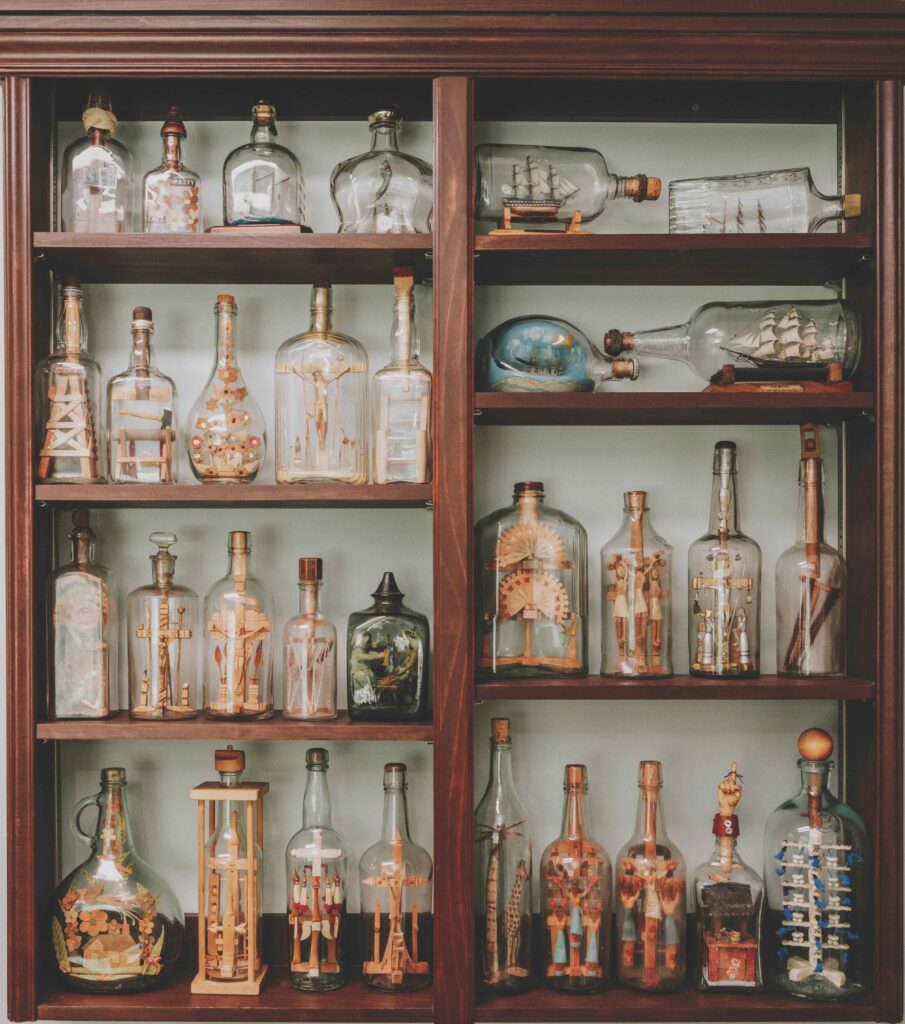
His collection extends far beyond ships. There are workshops, people, animals, buildings, and elaborate scenes, some created by Alvey and others dating back centuries.
“You really can have a lot of fun,” he said. “It’s only limited by your imagination for the most part.”
Alvey’s fascination with the unusual art form stretches back to childhood, when he remembers seeing ships in bottles advertised or pictured in comic books. But it was years later — and thousands of miles from home — that the passing curiosity began turning into something more.
Alvey served in the military during the Vietnam era as a North Vietnamese language specialist. He did not serve in Vietnam but was stationed on a remote tour where entertainment options were limited. He spent plenty of time in the library.
“One of the books I found there was a book by Commander Don Hubbard on putting ships in a bottle,” Alvey said. “As a kid, I remember seeing ads for ships in a bottle or little captions in comic books. So it was kind of a fascination, but I didn’t do anything about it until I got out of the military.”
That came in the mid-1970s. Alvey returned home during a difficult economy, initially with few job prospects. He eventually landed a job at Brescia University, but with a young family and little disposable income, an inexpensive hobby held plenty of appeal.
“I thought, you know, this is something that I could do without needing a lot of space, not a lot of expense, because most of it is scrap wood and homemade tools,” he said.
So he built his first ship in a bottle. He still has it.
The display has changed slightly over the decades — Alvey later added a lighthouse and scenery because the original composition looked too empty — but the bottle remains a marker of where a hobby spanning roughly half a century began.
For a while, he might build about one bottle a year. He enjoyed the process, but it wasn’t until the arrival of eBay in the 1990s that his interest took another turn.
Suddenly, Alvey wasn’t limited to whatever he could find in local antique stores. He could search the world.
“I started buying them real cheap, mostly,” he said. “In fact, I searched for the cheap ones because I couldn’t afford anything too good.”
Then he realized he could search international versions of eBay.
Alvey would sit at his computer with eBay Germany or eBay France on one part of the screen, a translation program on another, plus currency and metric conversion programs to decipher exactly what he was considering buying.
“Sure enough, I could find them,” he said. “So I started buying from European countries.”
Over the years, Alvey estimates he has bought or sold bottles in about 26 countries and developed friendships with collectors and artists around the world. At one point, he estimates he had owned 800 to 900 bottles. He sold roughly 400 to two brothers alone, a transaction that nearly convinced him to leave collecting behind.
Today, his collection is closer to 160 or 170 bottles. And while the sheer number is impressive, the real fascination comes from looking closely.
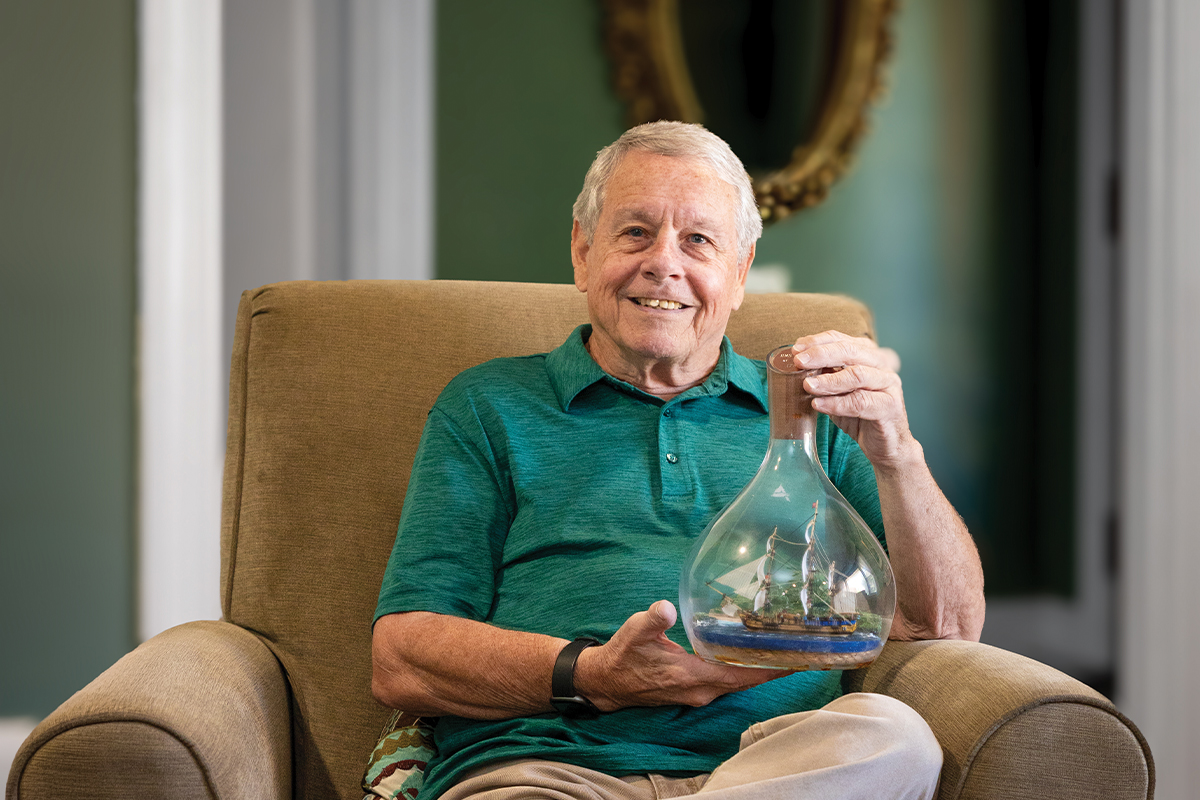
One of Alvey’s own creations depicts the HMS Bounty. It took about three months of off-and-on work and includes 17 tiny crew members climbing sails and moving about the ship.
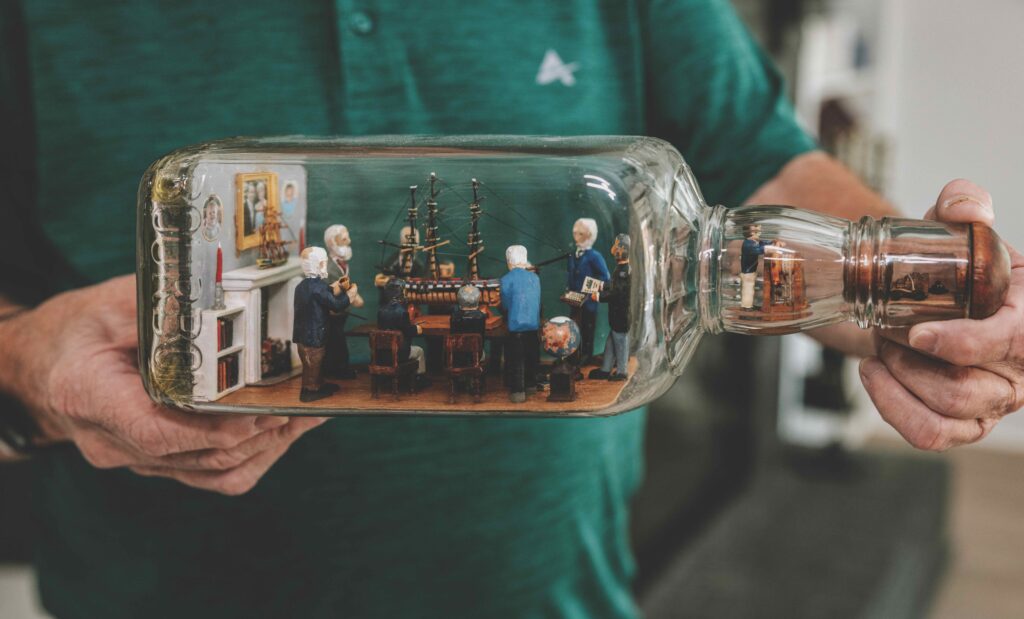
Another of his favorites depicts an Admiralty Board, inspired by the historical practice of constructing ship models for officials to examine before approving the real vessel for construction.
Alvey started the piece, got perhaps 60% or 70% finished, then set it aside for nearly four years. The finished scene includes figures personalized around his family. Alvey even hides identifying information inside some of his pieces. In the Admiralty Board scene, a miniature book identifies him as its maker.
“By being in the bottle, you know it’s authentic,” he said.
That attention to detail is especially evident in the Bounty. Alvey didn’t simply carve something resembling a ship and slide it through the opening. He individually planked the miniature deck with strips of wood. He made the wheel, masts, sails and rigging. He created the landscape and even made the “sea” from wood.
Everything had to be planned around one unavoidable restriction: It must fit through the neck of the bottle.
“Everything is scratch-built,” Alvey said. “It’s tempting sometimes to go to a dollhouse store and buy miniatures that already help. But no, everything is homemade, handmade.”
Traditional ships in bottles are generally constructed so the masts and sails fold against the ship. The collapsed model can then pass through the neck. Once positioned inside, strings attached to the rigging are carefully manipulated to pull the masts upright.
Then comes the small matter of cutting away the strings and finishing everything through an opening that might barely accommodate a finger.
Alvey makes many of his tools himself from wire. Over the years, he has also acquired long endoscopic instruments similar to those used by surgeons.
Before a piece ever reaches the bottle, Alvey may sketch the entire concept, work out individual components, and test each part against a tube the same diameter as the bottle’s neck.
Sometimes the idea comes first and Alvey finds a bottle to match it. Other times, the bottle itself provides the inspiration.
“You find a bottle that you think, ‘Wow, that’s beautiful,’” he said. “So you then let the bottle dictate what you might want to put in it.”
The results can be playful. One of Alvey’s creations is a “can of worms” scene featuring an overturned crate, raccoons, a turtle, and other tiny details. Another depicts a small café, complete with a menu and graffiti. For this year’s ROMP festivities, after recently joining the Owensboro Art Guild, Alvey created a bottle featuring a miniature band as part of an art display centered around bluegrass music.
Building one from scratch isn’t necessarily the hardest part. Restoring somebody else’s centuries-old creation can be even tougher.
“You have to kind of replicate the process,” Alvey said. “The object is to make it be original. You’re not trying to embellish it. You’re not trying to change it.”
Shipping antique bottle art presents an unusual problem. The glass itself can be protected relatively easily. The fragile contents inside cannot. A jolt can break century-old glue or knock miniature components loose, leaving Alvey with the task of somehow putting them back into position.
“I could more easily sit down and make my own bottle from scratch than restore someone else’s work,” he said.
The historical side of the art form eventually became just as fascinating to Alvey as making and collecting it.
One of the oldest pieces in his collection, which he calls the Cobbler’s Workshop, likely dates to roughly 1720 to 1740. Inside the green-tinted glass is a tiny scene of shoemakers apparently celebrating something.
“They either sold the shop, they had a big sale, they’ve done something,” Alvey said. “We don’t know what.”
The age makes the piece especially rare.
Although glassmaking stretches back thousands of years, Alvey said the availability of relatively clear glass bottles came much later. Bottles remained valuable objects rather than disposable containers, making the earliest surviving examples of bottle art particularly scarce.
Many pieces in Alvey’s collection date from the 1800s through the early 1900s. He said the art became increasingly prevalent in the United States as immigrants brought traditions with them and sailors created intricate pieces during long stretches away from land.
During hard economic times, including the Great Depression, bottle art could also become a way to earn money. That history pushed Alvey toward another project: documenting it.
As his collection grew, he created a website devoted to bottle art. What began as another part of his hobby eventually grew into what Alvey said is now the largest website of its kind in the world, featuring artists, historical information, building techniques, and examples from around the globe.
Alvey initially wondered whether the research might someday become a book. He eventually decided the internet was a better home for the information, particularly because so little has been written about bottle art compared with other artistic traditions.
“You look at works of art, works of Greek — you can find books galore on any aspect of it,” he said. “I think it’s because there’s really not a lot of literature on this, that it hasn’t gotten exciting to a lot of people. They just don’t know about it.”
Alvey hopes that eventually changes.
While commercially produced ships in bottles can be purchased inexpensively, he sees handmade examples as something entirely different: individual pieces of folk art that carry the fingerprints — sometimes literally and sometimes figuratively — of the person who made them.
Fine examples can sell for thousands of dollars, depending on age, craftsmanship, subject matter and the reputation of the artist.
These days, Alvey is slowly moving in the opposite direction from the collector who once searched websites across Europe. His adult children appreciate the collection but don’t necessarily want to inherit hundreds of bottles. The exceptions are the pieces Alvey made himself, which carry a different kind of value. So he is gradually selling much of what he accumulated.
That doesn’t mean he’s done creating. His interests have simply continued expanding. He draws, builds miniature ships, enjoys folk art, and recently started teaching himself to paint. Joining the Owensboro Art Guild is another step in exploring those interests.
He doesn’t describe any one medium as an all-consuming passion. His curiosity tends to move from one thing to another, sometimes disappearing for years before returning.
“I’m almost that jack-of-all-trades kind of notion,” Alvey said. “I would lose interest too fast. I enjoy this, but I might want to put it down for eight years and then come back and do it again.”
After roughly five decades, however, the bottles keep drawing him back. There is always another mystery to solve, another tiny object to carve and another seemingly impossible scene to coax through the narrow neck of a bottle.
“When I’m working on something,” Alvey said, “I really do enjoy it.”