

Hoskins reflects on 60 years in law enforcement
Photos by Jamie Plain
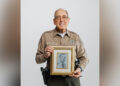
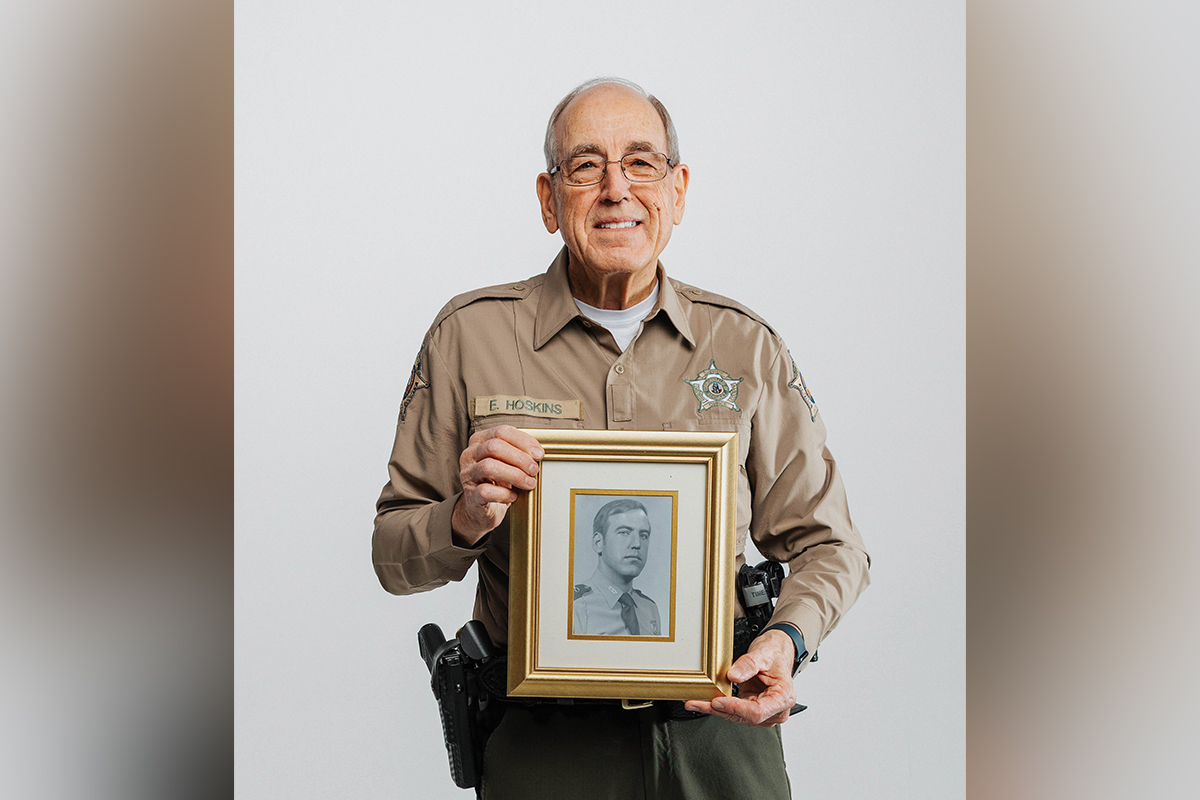
For 60 years, Ed Hoskins has shown up with a quiet sense of purpose, witnessing law enforcement change around him in ways he never could have imagined. He began his career without radios and not using handcuffs or a divider in the patrol car; today, he works in a courthouse shaped by layers of security and technology. The tools and titles have evolved, but the heart of the job — protecting people and doing what’s right — has never changed.
THE SIMPLICITY BEHIND HOW IT ALL STARTED
Hoskins’ path into law enforcement began when he noticed a cool patrol car cruising down the street.
“When I was in high school, my family and I lived out in the country between Whitesville and Knottsville,” he said. “Our neighbor, Ray Anderson, was a state trooper. I’d see him drive by in that black-and-white Plymouth and think, ‘Man, that guy’s sharp. I’d like to do something like that.’”
After graduating, Hoskins went to work in a chair factory and “completely forgot about becoming a state trooper.” But when a coworker applied to the Kentucky State Police Academy, Hoskins decided to give it a try.
“I went up to Frankfort and took the general knowledge test, and to my surprise, I passed the darn thing,” he said.
Hoskins was hired by KSP on Dec. 12, 1966, initially working as a dispatcher while waiting for an academy slot. Before he could start, Uncle Sam intervened.
“I got called up for active duty with the Army Reserve,” he said. “I spent about 6 months on active duty, then came back and started the State Police Academy in September of ’67.”
He graduated in January 1968, part of a class that marked a turning point in KSP history.
“Our class was the first class to have Black troopers graduate from the academy. There were no women at the time either,” Hoskins said. “You also had to be five-foot-nine-and-a-half. I remember one guy was one-eighth of an inch too short, and they sent him home.”
Seven members of Hoskins’ class were assigned to the Dry Ridge post in Northern Kentucky, a post many rookies didn’t want.
“We were basically just Highway Patrol,” he said. “We worked I-75. I had a brand-new ’68 Ford, two-door, no screen in the car. We had no portable radios, no tasers, and mace was disallowed.”
If someone was arrested, the decision was simple, but risky.
“We never handcuffed anybody unless they gave us trouble,” Hoskins said. “So you had to decide if you put them in the right rear so you could see them in the mirror, or in the front seat so you could watch them better. It was a precarious situation, but that’s just how it was back then.”
It was in northern Kentucky that Hoskins met his wife, Addie Mae.
“I met her at the Capri Restaurant, right there off I-75 and U.S. 42. She was a waitress. She made good milkshakes,” he laughed.
They married on Dec. 6, 1969, in a small Catholic church in Warsaw, Kentucky. A year later, Hoskins transferred back home to Daviess County, where he has since spent his career.
CHANGES IN PAY, POLICY, AND POWER
Over 27 years with KSP, Hoskins witnessed sweeping changes in pay, policy, and even power.
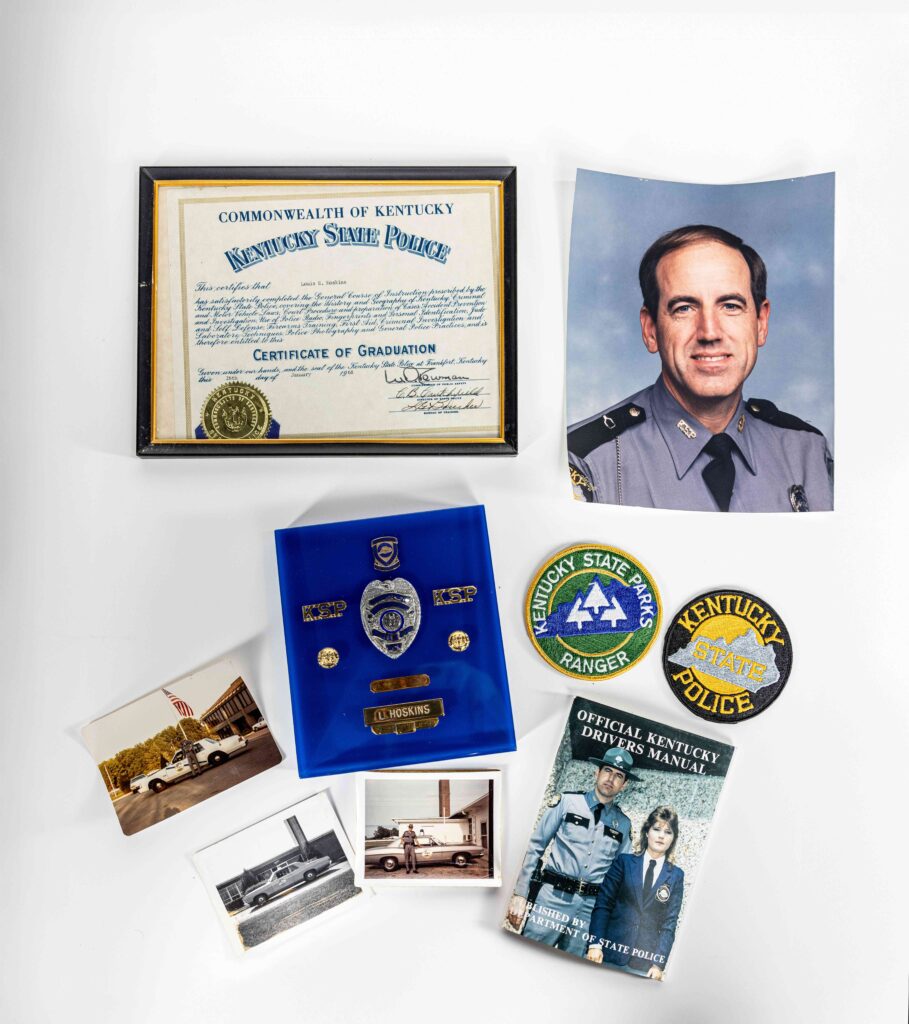
“When I started, I made $457 a month,” he said. “Gov. Wendell Ford brought us out of poverty. He gave us about a 15-percent raise, and then Julian Carroll gave us another tremendous raise.”
Weapons evolved from a Smith & Wesson .38 to a .357 Magnum, then semi-automatics. Patrol cars gained protective screens. Jurisdiction expanded.
“When I first transferred back to Owensboro, we had no authority in city limits,” Hoskins said. “If I followed a drunk driver into town, I couldn’t make the arrest. I had to call it in.”
He also worked during some of the most turbulent moments in Kentucky history, including court-ordered school busing riots in Louisville, Vietnam War protests at the University of Kentucky, and the United Mine Workers strike near Pleasant Ridge in 1977.
“They were throwing rocks and breaking windows, and one hit a school bus,” Hoskins said. “That’s when we charged the hill. Deputies got hurt. That was significant.”
But the moments that stayed with him most weren’t riots or protests. They were fatalities. One case in particular still weighs on him.
“In 1976, we investigated a five-fatality accident in Hancock County,” Hoskins said. “A drunk driving a semi ran over a ’69 Pontiac and killed a whole family, except for a little girl in the right rear seat. She didn’t get a scratch.”
Hoskins said the driver’s blood alcohol content was .13, at a time when the legal presumption of intoxication was .15.
“What was disheartening was the jury never found the guy guilty,” Hoskins said. “That’s hard when you know someone’s guilty, but they’re not found guilty.”
Still, Hoskins never lost sight of why he stayed.
“Getting a drunk driver off the road, preventing a fatality — that’s rewarding,” he said. “I remember arresting a drunk driver and feeling bad for his kids, but I did those kids a favor. He could’ve killed them.”
A RETIREMENT THAT DIDN’T STICK
Hoskins retired from KSP in September 1993, but he couldn’t sit still.
“I went straight to work as a park ranger at Audubon State Park,” he said. “When I was hired, the senior ranger said, ‘Ed, you won’t have to worry about writing tickets. Once in a while, you investigate a little fender bender.’”
On his very first night, during a pouring rainstorm, Hoskins arrested a drunk man who was unplugging RVs.
“I didn’t even have a raincoat yet,” he said. “So much for it being boring.”
From there, Hoskins spent 15 years as a court security inspector with the Administrative Office of the Courts, traveling the state with portable magnetometers for high-profile trials, protecting appellate judges, conducting courthouse security inspections, and teaching mandatory court security classes.
In the mid-2000s, a call from a retired trooper changed his course again.
“A friend called and said the Sheriff’s Office needed someone at the judicial building,” Hoskins said. “I said, ‘I’ll give it a try.’ That was 17 years ago.”
Today, Hoskins works as a court security officer with the Daviess County Sheriff’s Office, rotating through courtrooms, operating metal detectors, transporting inmates, and enforcing courtroom protocol.
“You never get bored,” he said. “Every day is different.”
Now 80, Hoskins says he may finally retire this year, though he jokes he’s been saying that for a while.
“I might take a break at age 80,” he said. “Spend more time with my kids. I’ve got five grandkids and a great-grandchild. And my grandson is starting the police academy next month.”
His wife, whom he calls Mae, supported his career, albeit with some quiet reservations.
“She never let on when I was working,” Hoskins said. “After I retired, she told me she worried about me all those years.”
CONTINUED HUMILITY AND DEDICATION
Earlier this year, Hoskins was recognized at a Daviess County Sheriff’s Office banquet for his 60 years of service — an honor that caught him completely off guard.
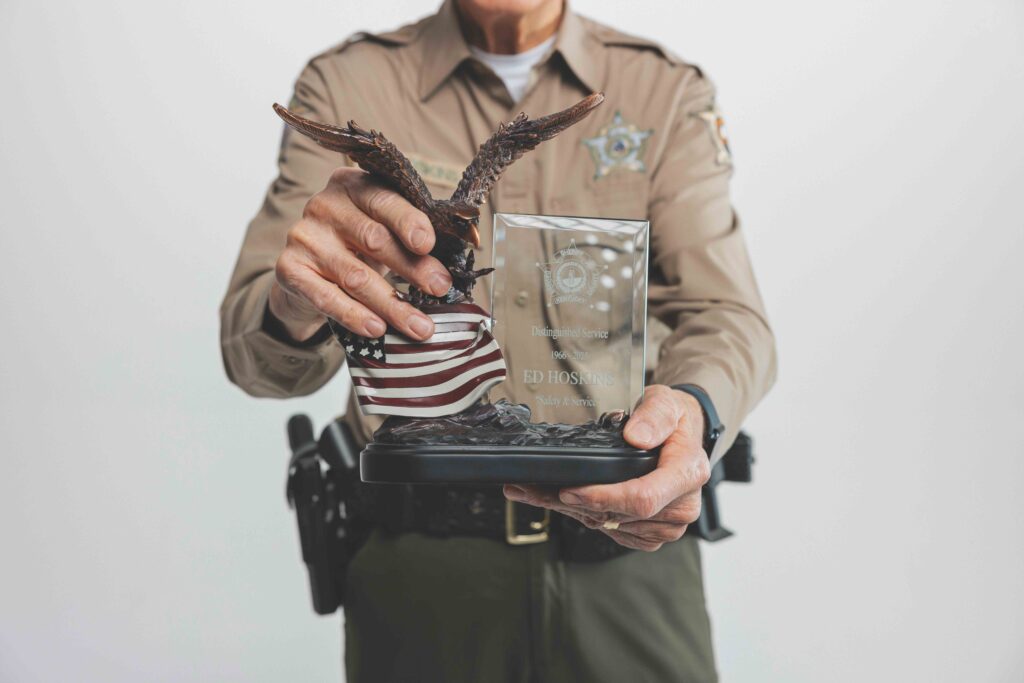
“I was totally shocked,” he said. “I thought maybe I was getting an award for shooting or something. I’m humble and grateful. It means a lot knowing people noticed.”
Asked what he would say to someone considering law enforcement today, Hoskins didn’t hesitate.
“It’s a rewarding career,” he said. “Don’t let the media dissuade you. You do a lot of good for the community. It’s a feel-good occupation.”
After six decades, countless changes, and more than a few rain-soaked nights, Hoskins is still doing what he set out to do. He quietly shows up and does the job the right way. OL